I would also like to take this time to thank four organizations that made this Kickstarter possible:
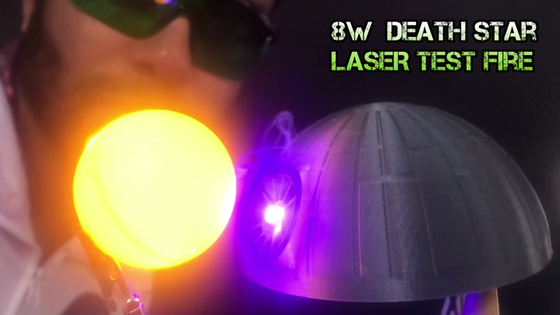
Robots Everywhere LLC - Matteo Borri thank you for the "Made in America" 8 Watt LASER. Your work at NASA to create three different Chlorophyll detectors for Mars is truly unchartered territory.
Microlaunchers (Closure in 2015) - Blair Gordon thank you for your business input on how to make Selfies in Space work, the photoshop design for the Digital Mission Badges, and the tag line "Take a pic, Share it NOT to the cloud, but to the UNIVERSE!"
FuseLeaf - Chris your marketing input has been amazing, thank you! Time to chat with Luke SkyWalker :) I can't wait to try some 3D printed edibles right before the rocket launch to calm the nerves.
United Frontiers - Sarah & Christopher hopefully your rocket explodes on its first flight (I did invite Luke Skywalker to the launch on Twitter), and we collect lots of useful data (See first three SpaceX Falcon 1 tests). Like in the movies we can always build a second Death Star for $4.5K I kid of course 🙂 I'm super excited to be on the flight with 20 other customers and to have the chance to view a rocket liftoff from a boat during its sea launch. To Black Skies!
73,
Blaze Sanders
Chief Designer @ DSiS
Update 10: Stress Analysis [TECH] - Will the Death Star explode under 5.5G load?
over 7 years ago
– Fri, Apr 19, 2019 at 10:16:18 AM
Have you ever wondered how a payload is designed to survive the stress of a launch? That’s where stress analysis comes in. During our launch, the payload will be subjected to up to 5.5 G’s (5.5 times the Earth’s gravitational pull) and extreme vibration. Analyzing all these stresses takes a lot of math, but it can be done to the first order with Onshape software. Onshape partners with SimScale to allow open source projects to simulate their CAD for $0 helping startups develop outstanding products for their customers and reinventing the future.
If all the forces, geometrical surfaces, and material properties are defined, the software can spit out accurate predictions of how the stresses and strains will play out on every point of the object. This information is represented on a computer screen in color contours, with the highest stresses/strains shown in red and the lowest in blue. Our stress analysis found that our custom-made heat resistant, flame retardant ULTEM 9085 sphere can easily survive the launch.
Tech updates will be released every 3 days. The next topic... Stress Analysis. You can ask technical questions in the comments below, on the April 11 Reddit AMA, or on Twitter using the hashtag #AskDSiS. I will answer all questions on a mid campaign Q&A Facebook LIVE video (www.facebook.com/blaze.sanders) on April 21th at 1 pm PT.
73,
Blaze Sanders
Chief Designer @ DSiS
Update 9: 56% Funded!!! FAQ & Why I Started This Project...
over 7 years ago
– Thu, Apr 18, 2019 at 04:08:28 PM
Hello World,
We are now 7 days into the campaign and are 56% funded!!! Thank you so much for the support. I wanted to answer the three most Frequently Asked Questions (FAQs) both here on Kickstarter and on the website at www.deathstarinspace.com/presskit
Why are you causing more orbital debris?
This is a huge waste of money!
LASER in space, is that legal...
Why are you causing more orbital debris?
The DSiS project will not cause ANY orbital debris and absolutely NOTHING gets released. Our suborbital mission goes up to 100 km and straight back down in less then 30 mins. For the entirety of the mission the Death Star, LASER, and exploded Alderaan's stay inside both a 1U CubeSat frame and the inside of the United Frontiers rocket fairing. We even did the math in case the rocket explodes mid flight, and the #DeathStar hardware falls back to Earth.
A UTLEM 2.4 kg 10cm sphere ejected from 110 km would have peak heating of 40 W/cm^2 and reach ~1500C, so if it does become separated, it's will burn up on entry.
This is a huge waste of money!
Cash spent on aerospace is not loaded into rockets and burnt up in the sun (a very hard thing to achieve by the way). It goes to the machinists, laborers, and project managers in both big and small towns around the USA. NASA has 10 centers for this very reason. Also since aerospace is so regulated its one of the few industries that can't outsource jobs from America.
The effective / dangerous distance of our 0.15 W and 8 W LASER’s are very short, and the Death Star will be inside of up to two boxes (1U CubeSat frame and rocket fairing cover) away from human eyes. We will check in with the FAA before launch and get all the required waivers. CubeSat mission such as NASA's ISARA mission have put LASER's into space already, and Elon Musk wants LASER’s in space to - so I’m just trying to help a brother out :)
Why I Started This Project...
Because I love SPACE, NASA, OPEN SOURCE, and STAR WARS! I started this project 2 years ago while at SpaceVR, because we needed something to film in 16K 360 degree video after the Overview One CubeSat was ejected from the International Space Station. The project now is focused on four short term goals and one long term goal:
Promote STEM education to kids by having a lot of fun and sending their GitHub code in to space.
Celebrate Yuri’s Night and honor Star Wars Celebration and Episode IX to bring fans together.
Etch & gold plate 300 Earthling names into the Death Star PCB’s, and then send it to space & back.
Launch a functional Death Star into space (100 km) and back for the first time in history.
Humanity will need to leave Earth at some point, so why not start today with small steps that prove technology like wireless power transfer using LASERs and supercapacitors works in space. The long term goal of this project is to send a Death Star into Low Earth Orbit (LEO) for at least 6 months and turn on its LASERS to transmit power to another CubeSat and/or send peoples names via light out of the solar system. Do you want to see that happen?
73,
Blaze Sanders
Chief Designer @ DSiS
Update 8: Space Thoughts
over 7 years ago
– Wed, Apr 17, 2019 at 06:36:11 AM
The idea behind capacitors is pretty simple. Take two metal plates, put them close together, and then roll them up to make them easier to use. Supercapacitors just take that idea to the extreme and "typically store 10 to 100 times more energy per unit volume or mass than electrolytic capacitors, can accept and deliver charge much faster than batteries, and tolerate many more charge and discharge cycles than rechargeable batteries" [1].
Tesla Energy will be purchasing Maxwell Technologies, a world leader in supercapacitors very soon. This same company will be going to space with us; however, since the DSiS project was started about two years ago - it seems like @ElonMusk is trying to stop anyone but themselves from putting an operational #DeathStar into space #ITSAJOKE :)
Our Death Star is powered by 350 F (not microFarad) supercapacitors! By putting three supercapacitors together in series a 8.1 Volt power storage system is created, with a total capacitance of 116 Farad. Solar panels and/or a barrel jack outputting 9 Volts at 2.5 Amps can then be used to recharge all three supercapacitors in 54 seconds.
Supercapacitors were selected over batteries early in the design process to enable easy charging during testing and while sitting on the United Frontiers rocket, the ability to both quickly absorb and output a crazy amount of power (150 A @ 8.1V = 1.2kW) in a small package, and because the name sounds awesome!!!
Tech updates will be released every 3 days. The next topic... Stress Analysis. You can ask technical questions in the comments below, on the April 11 Reddit AMA, or on Twitter using the hashtag #AskDSiS. I will answer all questions on a mid campaign Q&A Facebook LIVE video (www.facebook.com/blaze.sanders) on April 21th at 1 pm PT.